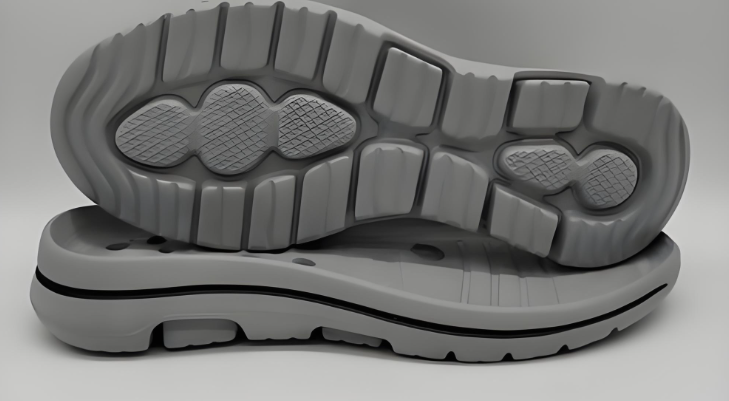
Key Words: EVA; Foamed Shoe Materials; SEBS; POE; SSBR EVA foamed shoe soles are widely used in casual shoes, sports shoes and other fields due to their advantages of light weight, low cost and easy processability. However, pure EVA has drawbacks such as insufficient resilience, brittleness at low temperatures and poor wear resistance, whose performance thus needs to be optimized with modifiers like SEBS, POE and SSBR. The core of selecting these three materials lies in prioritizing performance based on application scenarios; accurate matching of material to actual requirements can avoid redundant costs and performance waste. 1. If resilience, low-temperature resistance, wear resistance and anti-aging properties need to be balanced, low-styrene, high-resilience SEBS is the top choice. A low styrene content can improve compatibility with EVA, preventing delamination and embrittlement of the foam; high resilience can significantly optimize the cushioning performance of shoe soles, meeting the shock absorption requirements of sports shoes. Meanwhile, its saturated structure delivers excellent anti-aging and weather resistance, avoiding yellowing and embrittlement after long-term use. With better wear resistance than pure EVA, it is suitable for mid-to-high-end sports shoes and outdoor footwear, striking a balance between comfort and durability. Note that SEBS is more costly than POE, so it is necessary to balance performance with the cost budget. 2. If the core requirements are only focused on low-temperature resistance, resilience and anti-aging properties, POE is a cost-effective choice. POE is an ethylene-octene copolymer with no styrene structure, featuring excellent compatibility with EVA. It can be uniformly dispersed in the foaming system, which greatly improves the low-temperature toughness of shoe soles and prevents fracture in low-temperature environments. Its resilience is close to that of high-resilience SEBS, able to meet the comfort requirements of daily casual shoes and thermal shoes. In addition, it has excellent anti-aging properties and high processing stability, effectively avoiding uneven foaming issues. Its drawbacks are moderate wear resistance and slip resistance, making it unsuitable for high-frequency sports and outdoor wear-resistant scenarios. 3. If a balance of resilience, slip resistance and low-temperature resistance is required, high-styrene, medium-molecular-weight SSBR is recommended. A high styrene content enhances the hardness and slip resistance of shoe soles, making it suitable for casual shoes and safety shoes that demand anti-slip performance. The medium molecular weight balances processability and elasticity; when blended with EVA, it improves the rebound efficiency of the foam and mitigates low-temperature brittleness, thus being ideal for footwear used in low-temperature regions. However, SSBR is an unsaturated rubber with inferior anti-aging performance to SEBS and POE, which is prone to aging during long-term outdoor use and therefore requires compounding with anti-aging additives. In addition, the foaming process must be strictly controlled during production to prevent issues such as uneven cell formation and shrinkage deformation. In summary, the priority of performance properties must be clearly defined for material selection: low-styrene, high-resilience SEBS is the choice for mid-to-high-end footwear pursuing all-round performance; POE is optimal for daily casual shoes that prioritize low-temperature elasticity while controlling costs; high-styrene, medium-molecular-weight SSBR is recommended for applications focusing on slip resistance and low-temperature elasticity where the incorporation of anti-aging additives is acceptable. In practical applications, the addition ratio of modifiers can be flexibly adjusted according to the specific footwear positioning, service environment and cost budget to achieve an optimal balance between performance and cost.