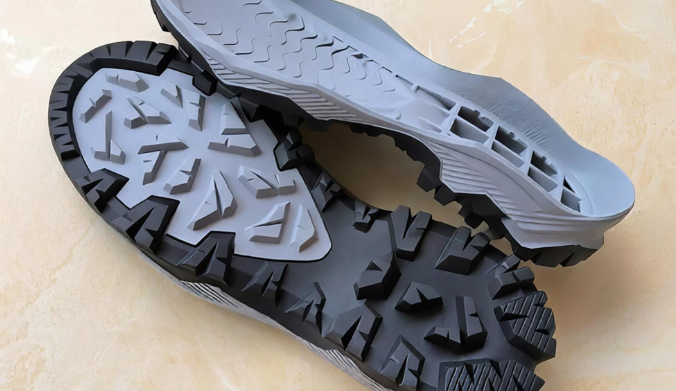
Finding the Right Balance Between Wet Grip, Abrasion Resistance and Flex Fatigue Performance For footwear compounders, BR- and SBR-based rubber compounds are well-established workhorse systems for outsole applications. Butadiene Rubber (BR) stands out for its excellent resilience and outstanding abrasion resistance, while Styrene-Butadiene Rubber (SBR) delivers balanced mechanical properties and stable processing. Both are widely used in running shoes, basketball shoes, casual footwear and everyday walking shoes. However, both systems share one notable limitation: grip tends to fall short on wet, slippery and icy surfaces, especially at low temperatures. To improve wet grip, formulators often incorporate Solution Styrene-Butadiene Rubber (SSBR) into their formulations. However, higher SSBR loading does not automatically translate to better performance. Too little may deliver limited grip improvement, while excessive addition can compromise abrasion resistance and flex fatigue performance. So, what is the optimal SSBR loading? It largely depends on the base rubber matrix. 1. BR vs SBR: Different Base Matrices, Different Performance Characteristics Before determining SSBR loading, it is important to understand the inherent differences between the two base polymers. A. BR-Based Outsoles BR is prized for its high resilience and excellent abrasion resistance, making it a popular choice for performance footwear, including competitive running shoes, basketball shoes and outdoor footwear requiring durable outsoles. That said, BR blends with SSBR generally feature a narrower formulation window. Compatibility between the two polymers has its limitations, and the blend can be sensitive to filler dispersion, especially when silica is used as a reinforcing filler. Excessive SSBR loading may lead to uneven polymer distribution and agglomeration, alongside poor silica dispersion. These issues can negatively affect the abrasion resistance and flex fatigue performance of finished outsoles. B. SBR-Based Outsoles Conventional SBR and SSBR share similar molecular structures, generally offering better compatibility and a wider formulation window. SBR systems are commonly used in casual shoes, commuting footwear and everyday running shoes, where comfort, wet grip and balanced durability are important. Thanks to their better compatibility, SBR matrices can generally accommodate higher SSBR fractions with a lower risk of phase separation and filler agglomeration. 2. Recommended SSBR Loading Ranges by Base Rubber Matrix All recommendations below refer to the SSBR proportion within the total rubber phase, not the total compound weight. A. BR-Based Outsoles (Competitive Running Shoes, Basketball Shoes and High-Wear Outdoor Footwear) Recommended SSBR loading: 15%–30% of the rubber phase Starting at around 15% SSBR can help improve wet grip under low-temperature conditions, depending on the overall formulation. Increasing the SSBR proportion towards 30% may further enhance wet traction while maintaining a reasonable balance with abrasion resistance and flex fatigue performance. Key consideration: Avoid exceeding 30% without careful formulation evaluation. Excessive SSBR loading may negatively affect polymer distribution and silica dispersion, potentially reducing abrasion resistance and increasing the risk of cracking during repeated flexing. For performance footwear, where durability is critical, maintaining the right balance is essential. B. SBR-Based Outsoles (Casual Shoes, Commuting Footwear and Everyday Running Shoes) Recommended SSBR loading: 20%–40% of the rubber phase Better compatibility gives SBR-based systems a wider formulation window and generally supports more uniform polymer distribution and filler dispersion. At around 20% loading, SSBR can help improve wet grip. Increasing the proportion to 30%–40% may deliver more noticeable improvements in wet traction while maintaining acceptable abrasion resistance and flex fatigue performance. Even so, excessive SSBR addition is not advisable, as it may also affect compound hardness and abrasion resistance. 3. How Does SSBR Improve Low-Temperature Wet Grip? SSBR features a relatively low glass transition temperature (Tg). A lower Tg helps the rubber maintain greater flexibility at low temperatures, allowing better conformity to wet and slippery surfaces and potentially improving friction and traction. This characteristic makes SSBR particularly useful for improving grip under low-temperature conditions around 0°C. However, actual grip performance also depends on the SSBR grade, polymer microstructure, filler system and overall compound formulation. SSBR should therefore be viewed as a performance modifier rather than a standalone solution. Its contribution to wet grip may come with trade-offs in abrasion resistance and resilience, depending on the formulation. This is why SSBR loading should be tailored to the footwear application and its specific performance requirements. 4. Finding the Right Formulation Balance There is no universal SSBR loading level for all rubber outsole applications. BR systems generally demand tighter dosage control, while SBR systems offer greater formulation flexibility thanks to their better compatibility with SSBR. Footwear manufacturers and compounders should always validate final formulations through application-specific testing, including wet grip, low-temperature traction, abrasion resistance, hardness and repeated flex fatigue performance. At DZBH, we continue to explore application opportunities for styrene-butadiene rubber materials and customized polymer solutions, helping footwear manufacturers strike the right balance between traction, durability and processability.