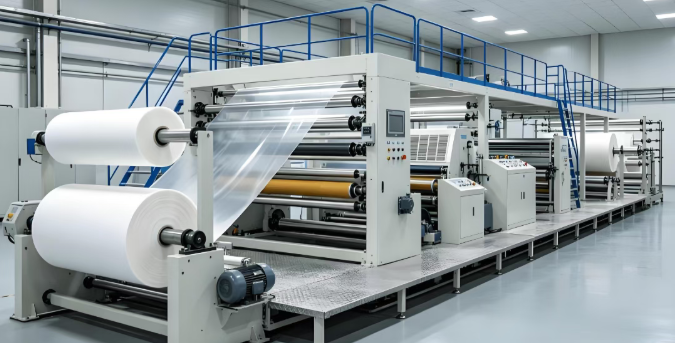
1. Balancing Multiple Performance Requirements in Hygiene Adhesives Baby diapers, sanitary napkins, and lightweight medical dressings commonly use nonwoven fabrics laminated with breathable polyethylene (PE) films. These structures must provide an effective liquid barrier while allowing water vapor to pass through, helping maintain dryness and comfort. To preserve the micropores in breathable PE films, manufacturers commonly use patterned hot-melt spray application rather than full-surface adhesive coating. However, adhesive formulators and production technicians often face several challenges. At high line speeds, adhesive stringing can leave fine filaments on product surfaces, affecting appearance and potentially contaminating production equipment. Even when spaying is smooth, adhesive dots may continue to spread after deposition, potentially blocking the micropores in PE films and reducing breathability. Two further challenges arise in different hygiene applications. Baby care products require a soft, skin-friendly feel, while adult hygiene products must withstand tensile stress during storage and use. Under elevated-temperature storage conditions, adhesive creep may cause adhesive migration, squeeze-out, or laminate delamination. A single polymer grade may not adequately address all these requirements. Selecting an appropriate elastomer base and fine-tuning the formulation with complementary polymer grades can help balance sprayability, softness, bonding performance, and creep resistance. 2. High-Flow SBS: A Base Polymer for Hot-Melt Spray Adhesives This specialized SBS grade is designed for use as a base polymer in patterned hot-melt spray adhesives for hygiene applications. Its high diblock content contributes to excellent melt flow, helping maintain smooth adhesive delivery at high line speeds and reduce the risk of nozzle clogging. It can also help improve wetting on low-surface-energy substrates such as PE film, supporting adhesion between the PE film and nonwoven fabric. Combined with a medium-to-high styrene content and a polybutadiene soft segment, the polymer helps balance cohesive strength and flexibility. After spraying, rapid adhesive setting can help minimize stringing and excessive spreading. Maintaining well-defined adhesive dots can help preserve the micropores in breathable PE films, supporting the product's breathability and liquid-barrier performance. This SBS grade provides a foundation for optimizing spray processing and substrate bonding in hygiene adhesive formulations. 3. Formulation Adjustments for Softness, Delamination Resistance, and Creep Control While the SBS base polymer addresses key spray-processing and bonding requirements, different hygiene applications may benefit from additional formulation adjustments using complementary styrenic block copolymer (SBC) grades. Baby Diapers and Lightweight Medical Dressings: Improving Soft Hand Feel A small proportion of SIS YH-1106 may be incorporated to soften the adhesive layer and reduce stiffness. This can improve flexibility and contribute to a softer feel in the finished product, an important consideration for applications requiring close contact with the skin. The appropriate addition level should be determined through formulation trials to maintain the desired sprayability and bonding performance. Adult Sanitary Products and Incontinence Care: Improving Resistance to Delamination and High-Temperature Creep Adult hygiene products may experience greater mechanical stress during use and temperature fluctuations during storage. Depending on the formulation and storage conditions, insufficient cohesive strength may contribute to adhesive creep, squeeze-out, or delamination under tensile stress. Incorporating a small proportion of SEBS 501T may help reinforce the adhesive layer and improve cohesive strength. It may also help reduce excessive adhesive flow at elevated temperatures, lowering the risk of squeeze-out and delamination. The actual performance improvement depends on the formulation, substrate combination, processing conditions, and storage environment and should be confirmed through application testing. Formulation Note The addition level of each complementary polymer grade should be carefully controlled. Excessive addition may alter melt viscosity and narrow the processing window, potentially leading to renewed stringing or excessive adhesive spreading. Successful formulation development requires balancing sprayability, substrate adhesion, flexibility, and long-term creep resistance according to the specific application and production conditions. Have you encountered adhesive stringing, blocked micropores in breathable films, or adhesive squeeze-out and delamination after high-temperature storage? Share your experiences and formulation insights with us.