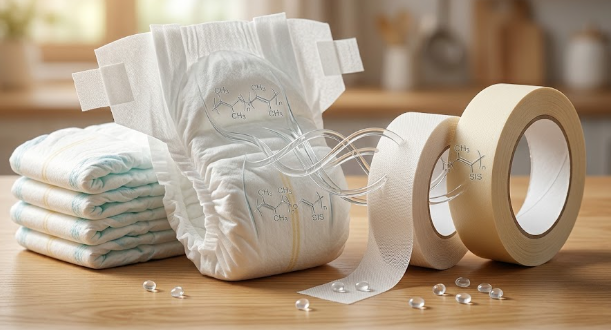
As adhesive manufacturers increasingly move toward solvent-free technologies, hot-melt pressure-sensitive adhesives (HMPSAs) are gaining importance across the hygiene and adhesive tape industries. However, selecting the right polymer remains a challenge: conventional SBS offers strong cohesion but can be difficult to process as a hot melt, while SIS provides excellent tack and melt flow but often comes at a higher material cost. For many manufacturers, the solution has been to blend SBS and SIS to achieve a balance of performance. While effective, this approach can make formulation development and production more complicated. A ew SBS solution, DZ-4014, offers another approach. Designed specifically for HMPSA applications, DZ-4014 combines the strong cohesion and structural stability associated with SBS with the softness, initialtack and melt flow characteristics typically desired from SIS. In suitable formulations, it can serve as the main polymer, helping manufacturers simplify formulations while improving processing and cost efficiency. 1. The Challenge: Balancing Tack, Cohesion and Processability Conventional SBS: Strong Cohesion with Processing Challenges SBS has long been used in adhesive applications because of its good cohesive strength and bonding performance. Its strong polymer structure helps provide durable adhesion and resistance to deformation. However, conventional SBS can present challenges in hot-melt applications. Its relatively hard structure, limited initial tack and high melt viscosity may make it more difficult to process, particularly on high-speed coating lines. Higher processing temperatures may be required to achieve sufficient melting and flow, potentially increasing the thermal load on the adhesive during production. For manufacturers looking to produce smooth, stable HMPSA coatings, conventional SBS may therefore require additional formulation adjustment or blending with other polymers. SIS: Excellent Tack and Melt Flow, but Higher Material Cost SIS offers a different performance profile. Its soft structure, excellent initial tack and good melt flow make it highly suitable for many pressure-sensitive adhesive applications. However, the higher cost of SIS can increase formulation expenses. Manufacturers may therefore choose to blend SBS and SIS to balance adhesion, cohesion and processing characteristics. While blending can achieve the desired performance, it also introduces additional variables into the formulation. The ratio between different polymers needs to be carefully controlled, and changes in raw material characteristics can require further formulation adjustments. This can increase development time, production complexity and inventory requirements. An improperly balanced formulation may also lead to problems such as unstable tack, adhesive residue or insufficient cohesive strength. 2. A New SBS Approach: Combining Key Performance Characteristics To address these challenges, SBS DZ-4014 has been developed for hot-melt pressure-sensitive adhesive applications. Rather than relying on conventional SBS characteristics alone, DZ-4014 is designed to provide a more balanced combination of: Cohesive strength Initial tack Softness Melt flow Hot-melt processability This combination allows DZ-4014 to bridge some of the performance differences between conventional SBS and SIS. Strong Cohesion with Improved Tack DZ-4014 maintains the cohesive characteristics expected from an SBS-based polymer while providing improved softness and initial tack. For pressure-sensitive adhesives, this balance is important. Excessive softness can affect cohesive strength, while excessive hardness can reduce initial adhesion and substrate wetting. DZ-4014 is designed to provide a more balanced adhesive profile, helping formulators achieve reliable tack while maintaining sufficient cohesion. Improved Melt Processability Another important characteristic of DZ-4014 is its improved melt flow compared with conventional SBS grades. Its lower melt viscosity allows the polymer to melt and flow more readily during hot-melt processing. This can provide greater flexibility in processing conditions and facilitate stable coating operations. Improved melt processability can also help manufacturers avoid unnecessarily high processing temperatures, reducing excessive thermal exposure during production. For applications involving lightweight substrates, its combination of softness, tack and melt flow can also promote good substrate wetting and smooth coating performance. 3. Simplifying Formulations and Improving Production Efficiency Using One Main Polymer One of the key advantages of DZ-4014 is its ability to serve as the main polymer in suitable HMPSA formulations without requiring SIS blending. Instead of using multiple polymer grades to balance tack, cohesion and processing characteristics, formulators can evaluate DZ-4014 as a single main polymer. This approach can reduce formulation complexity and the number of variables that need to be adjusted during development and production. For manufacturers, a simpler formulation can mean easier process control, faster formulation optimization and more straightforward production management. Reducing Raw Material and Inventory Complexity The benefits of formulation simplification extend beyond the mixing process. Reducing the number of polymer grades required can also streamline raw material procurement and inventory management. Manufacturers may be able to reduce the number of materials that need to be purchased, stored and managed. At the same time, a simplified formulation can help reduce the labor and processing effort associated with repeated formulation adjustments. Together, these factors create an opportunity to improve overall manufacturing efficiency while maintaining the performance required for HMPSA applications. 4. Balancing Performance and Cost For adhesive manufacturers, polymer selection is not simply a question of achieving the highest possible adhesion. The overall formulation must also deliver a practical balance between performance, processing and cost. DZ-4014 provides a cost-efficient approach by combining multiple desirable performance characteristics in one SBS-based polymer. In suitable formulations, it can provide: Good initial tack + strong cohesion + improved melt flow + simplified formulation This balance can help manufacturers reduce their reliance on more complex SBS/SIS blending strategies. The potential benefits include lower formulation complexity, simplified inventory management and improved processing efficiency. 5. Applications Across Hygiene and Adhesive Tape Markets The balanced performance profile of DZ-4014 makes it suitable for a range of conventional HMPSA applications. Hygiene Products DZ-4014 can be evaluated for backsheet bonding applications in disposable hygiene products, including: Baby diapers Sanitary napkins Other disposable hygiene products In these applications, adhesives need to combine reliable bonding with softness, stable coating performance and clean removal. Medical Adhesive Tapes DZ-4014 can also be considered for medical breathable adhesive tapes, where a balance between adhesion, cohesion and substrate compatibility is important. Masking Tapes For general-purpose masking tapes, the combination of initial tack, cohesive strength and melt processability can provide a practical basis for developing hot-melt adhesive formulations. 6. Suitable for Different Production Environments DZ-4014 can be evaluated on both high-speed continuous coating lines and conventional hot-melt adhesive production equipment. For high-speed production, stable melt flow and consistent coating performance are critical. For small and medium-sized manufacturers, formulation simplicity and process control can be equally important. By combining balanced adhesive properties with improved melt processability, DZ-4014 provides manufacturers with a practical option for optimizing HMPSA formulations across different production environments. Conclusion The transition toward solvent-free adhesive technologies is creating new demands for polymers that can balance adhesion, cohesion, processability and cost. Conventional SBS and SIS each provide valuable performance characteristics, but achieving the right balance may require complex blending strategies. SBS DZ-4014 offers a different approach by combining key performance characteristics associated with both SBS and SIS in a single polymer. With good cohesion, initial tack, softness and improved melt flow, DZ-4014 can serve as the main polymer in suitable HMPSA formulations, helping manufacturers simplify formulation design, streamline production and improve cost efficiency. For manufacturers of hygiene products, medical adhesive tapes, masking tapes and other hot-melt pressure-sensitive adhesive products, DZ-4014 provides a practical option for further formulation evaluation.