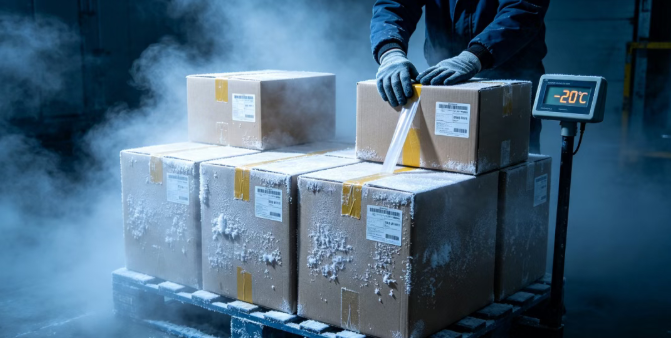
In cold chain warehousing and frozen logistics, ultra-low temperature environments of -20°C or below have become common operating conditions. However, conventional labels and carton sealing tapes often face a recurring challenge: They perform well at room temperature but lose initial tack and adhesion performance after entering cold storage, resulting in label slipping, edge lifting, curling, detachment, and shifting. These issues can affect product traceability, warehouse sorting efficiency, and logistics operations, increasing rework and operational costs. Improving adhesion reliability under ultra-low temperature conditions has therefore remained a long-standing challenge for the adhesive industry. 1. The Root Cause of Low-Temperature Adhesion Failure: Not Simply “Frozen Adhesive,” But a System Performance Imbalance Many people assume that low-temperature label failure occurs because the adhesive layer becomes frozen. In reality, the failure mechanism of conventional SIS-based PSAs is closely related to the compatibility between tackifier resin systems and elastomer molecular structures, together with the low-temperature rheological behavior of the adhesive system. 1.1 Conventional SIS Molecular Structure Limits Low-Temperature Flowability Most conventional SIS grades feature relatively high styrene content and low diblock content. While styrene hard domains provide cohesive strength, excessive rigid segments restrict molecular mobility under low-temperature conditions. As temperature decreases: Molecular chain movement becomes restricted; Adhesive flowability decreases significantly; The system cannot effectively compensate for tackifier hardening effects; The adhesive layer becomes stiff and less flexible, increasing the risk of delamination and cracking over time. 1.2 Rough and Porous Substrates Increase Bonding Difficulties Cold chain packaging commonly involves rough and porous substrates, including corrugated cardboard, wooden packaging, and fiber-based materials. Under low-temperature conditions, adhesives with insufficient flowability cannot effectively wet and penetrate the microstructure of these substrates. As a result, the actual contact area is reduced, bonding remains superficial, and adhesion failure may occur more easily under stress. 2. Targeted Solution: High-Flow, Low-Styrene, High-Diblock SIS Blending Approach To address ultra-low temperature bonding challenges, a specialty linear SIS featuring high flowability, low styrene content, and optimized high-diblock molecular design can be incorporated into existing SIS and SSBR-based formulations. Through molecular structure optimization, this specialty SIS improves low-temperature chain mobility and adhesive rheology, helping overcome the limitations of conventional PSA systems. 2.1 Low Styrene + High Diblock Structure: Maintaining Low-Temperature Flexibility By reducing rigid styrene hard segment restriction while maintaining sufficient flexible rubber segments, SIS molecular chains can retain better mobility under sub-zero conditions. This helps reduce adhesive stiffening and embrittlement while improving flexibility and stress relaxation capability. 2.2 Ultra-High Melt Flow Performance (MFR >12): Enhancing Low-Temperature Rheology With melt flow performance exceeding conventional SIS grades, this specialty SIS provides excellent low-temperature flow behavior. It enables the adhesive layer to maintain improved wetting and spreading ability, effectively buffering the hardening effects of tackifiers without requiring a significant reduction in tackifier loading. As a result, PSA manufacturers can achieve a better balance between room-temperature tack and low-temperature adhesion performance. 2.3 Excellent Compatibility for Flexible Formulation Integration This specialty SIS can be blended with mainstream SIS and SSBR elastomers with excellent compatibility. Without requiring major changes to existing production processes or extensive reformulation, adhesive manufacturers can achieve a cost-effective pathway for upgrading cold-chain adhesive performance. 3. Core Performance Advantages for Cold Chain Applications 3.1 Ultra-Fast Initial Tack at Sub-Zero Temperatures Even below -20°C, this SIS-based formulation maintains good wetting ability and rapid adhesion performance. It helps address common cold-chain application challenges, including poor initial grab, label slipping, and immediate detachment during low-temperature labeling and packaging operations. 3.2 Stable Holding Power During Long-Term Cold Storage Unlike conventional adhesives that may show acceptable initial tack but fail during extended storage, this optimized SIS blending system provides stable low-temperature cohesion. Under prolonged cold storage and temperature-cycling conditions, labels and sealing tapes can maintain better resistance against edge lifting, shifting, and detachment. 3.3 Improved Adhesion on Rough and Porous Substrates Excellent low-temperature flowability enables better contact with rough and porous surfaces such as cardboard, wood, and fiber-based materials. By improving surface wetting and mechanical interlocking, the adhesive system provides more reliable bonding performance for challenging substrates. 4. Application Areas This low-temperature SIS-based PSA system is designed for a wide range of cold-chain applications, including: Cold storage traceability labels; Frozen goods carton sealing tapes; Cold-chain identification and anti-counterfeiting labels; Wooden and fiber-based packaging bonding; Low-temperature bonding on porous and irregular substrates. Through molecular structure optimization and formulation flexibility, high-flow, low-styrene SIS provides an effective elastomer solution for upgrading cold-chain adhesive products. Customized SIS Solutions for Low-Temperature PSA Applications We provide customized SIS solutions for low-temperature PSA applications, supported by application engineers who can assist with: Formulation optimization; Trial evaluation; Performance validation. Our technical team is ready to support your development of reliable cold-chain adhesive solutions with suitable elastomer technologies.