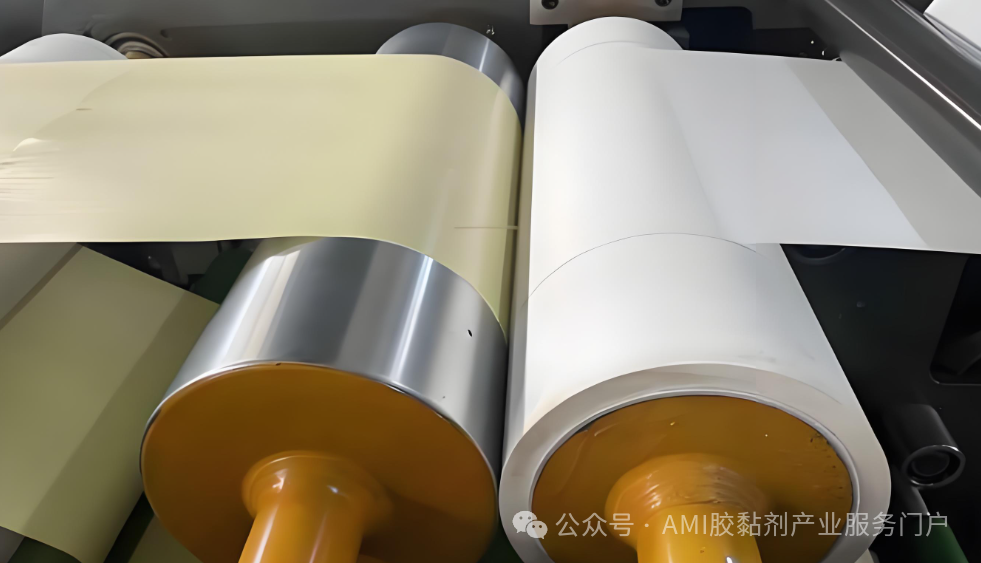
The personal care label, cold-chain label, and premium self-adhesive label industries rely heavily on high-speed automated hot melt coating lines. Conventional general-purpose SIS grades, which are predominantly triblock in structure with high styrene content, suffer from high melt viscosity and poor flowability. At high line speeds, the elevated melt resistance and poor leveling behavior result in uneven coating, surface particles, feed stuttering, and poor spray atomization — severely limiting equipment throughput and surface quality yield. Conventional triblock SIS maintains a complete crosslink network with high toughness and extensibility. During high-speed die-cutting and slitting, the PSA layer tends to stretch and elongate rather than break cleanly, causing stringing at the blade edge, failure to cut through, blade fouling, and label defects such as ragged edges, lifted corners, broken labels, and high reject rates. This makes it incompatible with the precision and speed demanded by modern label production. Cold-chain logistics labels operate continuously in low-temperature environments. Conventional SIS systems tend to stiffen at low temperatures, with reduced wetting ability, resulting in insufficient initial tack, poor conformability, label lifting, and detachment. High-speed label PSA must simultaneously deliver: low melt viscosity, high flowability, easy leveling, high initial tack, high flexibility, clean die-cutting without stringing, and reliable performance at low temperatures. Selecting the right SIS grade is the key. The grade described below is custom-engineered for exactly these requirements. With a styrene content of approximately 16%, the hard-segment rigidity and molecular entanglement are substantially reduced. The resulting polymer is highly flexible at the molecular level, with low melt resistance — fundamentally enabling the low viscosity, high flowability, and easy melt-leveling required for high-speed processing. A diblock content of approximately 55% significantly disrupts the continuous triblock network, weakening gel toughness and extensibility. This imparts a brittle-fracture characteristic to the PSA layer — enabling clean, sharp cuts during die-cutting and slitting with no stringing and no blade fouling. Low tensile strength combined with elongation at break up to 800% gives the adhesive layer exceptional softness and conformability. The material wets substrates effectively, remains flexible at low temperatures, and maintains stable initial tack across a wide temperature range. The high melt flow index and low viscosity allow rapid melting and superior flow in hot melt systems, making this grade well-suited for high-speed hot melt coating and spray application. The coated surface is smooth and uniform — free of particles and pinholes — significantly improving line speed and production stability. The low viscosity and high solubility also support rapid dissolution in solvent-based coating processes. Conventional triblock SIS is too tough to cut cleanly — it stretches rather than breaks under blade pressure, causing stringing and blade fouling. The high-diblock molecular architecture of this grade enables instantaneous brittle fracture at the cut point: cuts are clean and flat with no stringing, no blade sticking, and no connected edges. This makes it fully compatible with high-speed die-cutting and slitting, substantially reducing scrap rates. The low-hardness, high-flexibility structure gives the PSA excellent wetting ability on rough, cold, and curved substrates. The adhesive does not harden or lose tack at low temperatures, ensuring reliable label conformability and eliminating the lifting and detachment failures common in cold-chain applications. ● Personal care product labels — high-speed self-adhesive production lines ● Cold-chain logistics labels — low-temperature environments requiring reliable tack ● Premium self-adhesive label stock and fine flexible label products ● Primary: high-speed hot melt coating, hot melt spray coating ● Compatible: solvent-based coating — suitable for multi-process production facilities This grade delivers across-the-board improvements in processing efficiency, die-cutting performance, and low-temperature adhesion compared to conventional imported diblock SIS grades. It is the dedicated upgrade material for high-speed, high-surface-quality, easy-slit label PSA applications — directly resolving the three core challenges facing the label industry: slow coating, poor die-cutting, and insufficient low-temperature tack.Part I. Production Pain Points in High-Speed Label Coating & Die-Cutting
1.1 High-Speed Coating Challenges
1.2 High-Speed Die-Cutting & Slitting Challenges
1.3 Low-Temperature Application Challenges
Part II. Core Structural Design Features
2.1 Low Styrene Content
2.2 Ultra-High Diblock Content
2.3 High Flexibility / Low Strength Architecture
Part III. How This SIS Solves Label Production Pain Points
3.1 Resolving Coating Flow and Leveling Issues
3.2 Eliminating Die-Cutting Stringing and Blade Fouling
3.3 Restoring Low-Temperature Initial Tack and Adhesion
Part IV. Application Scope & Substitution Value
4.1 Primary Application Scenarios
4.2 Compatible Processes
4.3 Substitution Advantage