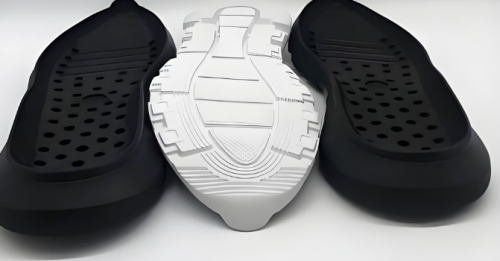
Which SSBR (Sulfur-Sulfur-Bromine Rubber) offers the best balance of enhanced EVA foam shoe material resilience, highest efficiency, and lowest cost? In optimizing formulations for mid-range EVA foam shoe materials, SSBR emerges as the ideal choice for enhancing resilience while reducing production costs. Compared to traditional SEBS modification methods, SSBR demonstrates closer solubility parameters with EVA, ensuring more uniform dispersion in the system. The double bonds in its molecular chains facilitate cross-linking reactions, enabling superior resilience efficiency with reduced additives—effectively balancing performance enhancement and cost control. 1.Reference Formula (Mid-range EVA Foam Shoe Material) Reference Formula of EVA Foam Shoe Material for Middle Grade Item Parts Quality portion matrix resin EVA(VA18%) 100 modified Elastomer SSBR(low styrene content, medium molecular weight) 8-12 Foaming agent AC agent 4-5 Foaming agent ZnO 1.5/1 Crosslinking agent DCP 0.8 filler Light calcium carbonate 15-20 2.Formula Explanation: Logic for Elastomer Selection The SSBR with low styrene content and medium molecular weight offers two key advantages: First, it demonstrates excellent compatibility with EVA's solubility parameters, enabling uniform dispersion without additional compatibilizers and preventing performance fluctuations caused by phase separation. Second, the double bonds in its molecular chains can co-crosslink with EVA to form a stable three-dimensional network structure. Compared to SEBS, which relies solely on physical blending for modification, SSBR achieves significantly higher rebound efficiency. Moreover, its dosage requirement is only 8-12 parts (far lower than the conventional 15-20 parts for SEBS), substantially reducing raw material costs. The synergistic action of the crosslinking agent DCP simultaneously initiates free radical crosslinking in EVA and double bond crosslinking in SSBR, forming a mutual-penetration network between the two resins. This enhances the toughness and resilience of foam cell walls, effectively addressing the issues of poor rebound and collapse in mid-range EVA foam shoe materials. The cost advantage of this approach is further demonstrated when compared to the SEBS solution. With equivalent rebound performance requirements, SSBR offers a lower market price than SEBS while requiring 30%-40% less additive. This reduces overall raw material costs by 15%-20%, making it a more cost-effective choice for mid-range EVA foam shoe materials.