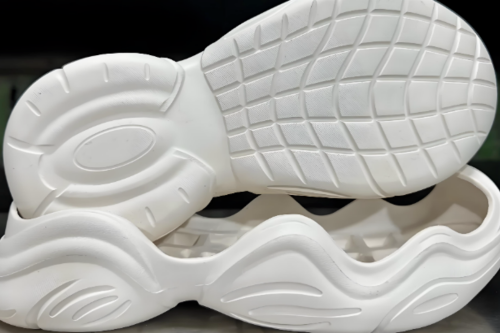
I. Functions and Proportion Principles of These Four Synthetic Rubber in Formulations EVA foam shoe materials are typically blended with four synthetic rubbers—SEBS, SSBR, POE, and EPDM—to address the performance limitations of pure EVA. The core applications, component ratios, and performance correlations of each material, along with the critical role of vulcanization, are as follows: SEBS: Designed to enhance resilience, tensile strength, and permanent compression resistance, effectively preventing long-term collapse of shoe materials under pressure. It also improves aging resistance. Oil-free formulation is recommended (to avoid elastic degradation). Recommended ratio: 5%-15 parts. When the content is ≤5%, the rebound and anti-collapse effects are not significant. When the content is ≥15%, it may increase system viscosity and affect foam uniformity. Suitable for sports shoes and casual shoes that prioritize high elasticity and wear resistance. SSBR: Prioritize high-styrene grades to enhance sole slip resistance and wear resistance, effectively addressing rain-related slip issues and rapid daily wear. Recommended ratio: 8%-15 parts. Usage <8% provides limited slip resistance; usage>15% may cause low-temperature hardening of shoe materials. Pair with POE to balance flexibility, ideal for outdoor and commuting shoes. POE: Focus on enhancing low-temperature toughness to prevent material hardening and cracking at sub-20°C. Simultaneously, improve system resilience and processability for optimized foaming performance. Recommended ratio: 5%-20 parts. Usage ≤5% shows inadequate low-temperature performance improvement; ≥20% may compromise material support, suitable for winter footwear and soft-soled home shoes. EPDM: Primarily enhances the weather resistance of shoe materials (UV resistance, moisture-heat aging resistance) while improving mechanical strength and cell stability, effectively reducing cell collapse and rupture during foaming. Recommended ratio: 5%-12 parts. Usage <5% results in poor weather resistance and cell stability; usage>12% may cause a stiff texture and increased processing difficulty, suitable for outdoor footwear designed for long-term use. The core relationship between formulation and performance: EVA accounts for 60%-80% of the base material, determining the lightweight foaming characteristics of the shoe material. The four rubber types collectively make up 20%-40% of the total, with adjustments required based on performance requirements. To enhance elasticity and resistance to collapse, increasing the proportion of SEBS is recommended. For better wet slip resistance and wear resistance, more SSBR should be used. To improve low-temperature comfort, raising the POE content is advisable. In outdoor applications, boosting the EPDM content is essential. II. Critical Role of DCP in Vulcanization EPDM molecular chains are saturated, while SSBR requires cross-linking and curing to achieve performance. As the core vulcanizing agent, DCP initiates chemical cross-linking between them through free radical reactions: it forms a stable three-dimensional network in EPDM, fully releasing its weather resistance and mechanical strength; it cross-links the double bonds and carbon-carbon bonds of SSBR, locking in wear resistance and anti-slip properties, while also promoting interfacial bonding between EPDM, SSBR, and EVA/POE systems to prevent phase separation, ensuring the overall structural stability and durability of the shoe material. The recommended dosage of DCP is 0.8-1.2 parts, with 0.3-0.6 parts of TAIC as a co-vulcanizing agent for enhanced performance.